
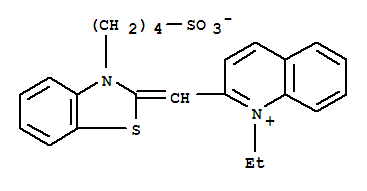
1-ethyl-2-[[3-(4-sulphonatobutyl)-3H-benzothiazol-2-ylidene]methyl]quinolinium
- Name: 1-ethyl-2-[[3-(4-sulphonatobutyl)-3H-benzothiazol-2-ylidene]methyl]quinolinium
- CAS: 63912-44-7
- Purity: 99%
Details
Manufacturer supply 1-ethyl-2-[[3-(4-sulphonatobutyl)-3H-benzothiazol-2-ylidene]methyl]quinolinium 63912-44-7 with sufficient stock and high standard
- Molecular Formula: C23H24 N2 O3 S2
- Molecular Weight: 440.5783
- Boiling Point: °Cat760mmHg
- Flash Point: °C
- PSA: 120.35000
- Density: g/cm3
- LogP: 4.24400
1-ethyl-2-[[3-(4-sulphonatobutyl)-3H-benzothiazol-2-ylidene]methyl]quinolinium(Cas 63912-44-7) Usage
|
Structure |
Quinolinium core with an ethyl group at the first position, a benzothiazolylidene-methyl group at the second position, and a sulphonatobutyl substituent |
|
Function |
Fluorescent dye used to detect and visualize amyloid fibrils in biochemistry and neuroscience research |
|
Relevance |
Implicated in neurodegenerative diseases such as Alzheimer's and Parkinson's |
|
Property |
Exhibits strong fluorescence upon binding to amyloid structures |
|
Application |
Valuable tool for studying and diagnosing amyloid-related diseases, potential use in drug development and screening for compounds that can inhibit amyloid formation. |
|
General Description |
1-Ethyl-2-[[3-(4-sulphonatobutyl)-3H-benzothiazol-2-ylidene]methyl]quinolinium, also known as Thioflavin T, is a fluorescent dye commonly used in biochemistry and neuroscience research to detect and visualize amyloid fibrils, which are implicated in a variety of neurodegenerative diseases such as Alzheimer's and Parkinson's. The molecule contains a quinolinium core with an ethyl group at the first position and a benzothiazolylidene-methyl group at the second position, along with a sulphonatobutyl substituent. Thioflavin T exhibits strong fluorescence upon binding to amyloid structures, making it a valuable tool for studying and diagnosing amyloid-related diseases. Additionally, it has potential applications in drug development and screening for compounds that can inhibit amyloid formation. |
InChI:InChI=1/C23H24N2O3S2/c1-2-24-19(14-13-18-9-3-4-10-20(18)24)17-23-25(15-7-8-16-30(26,27)28)21-11-5-6-12-22(21)29-23/h3-6,9-14,17H,2,7-8,15-16H2,1H3
Related Products
-
-
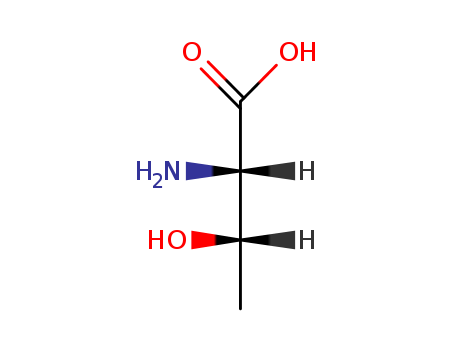 L(+)-allo-Threonine
CAS:28954-12-3
-
-
 4-Bromo-1,8-naphthalic anhydride
CAS:81-86-7